What it is
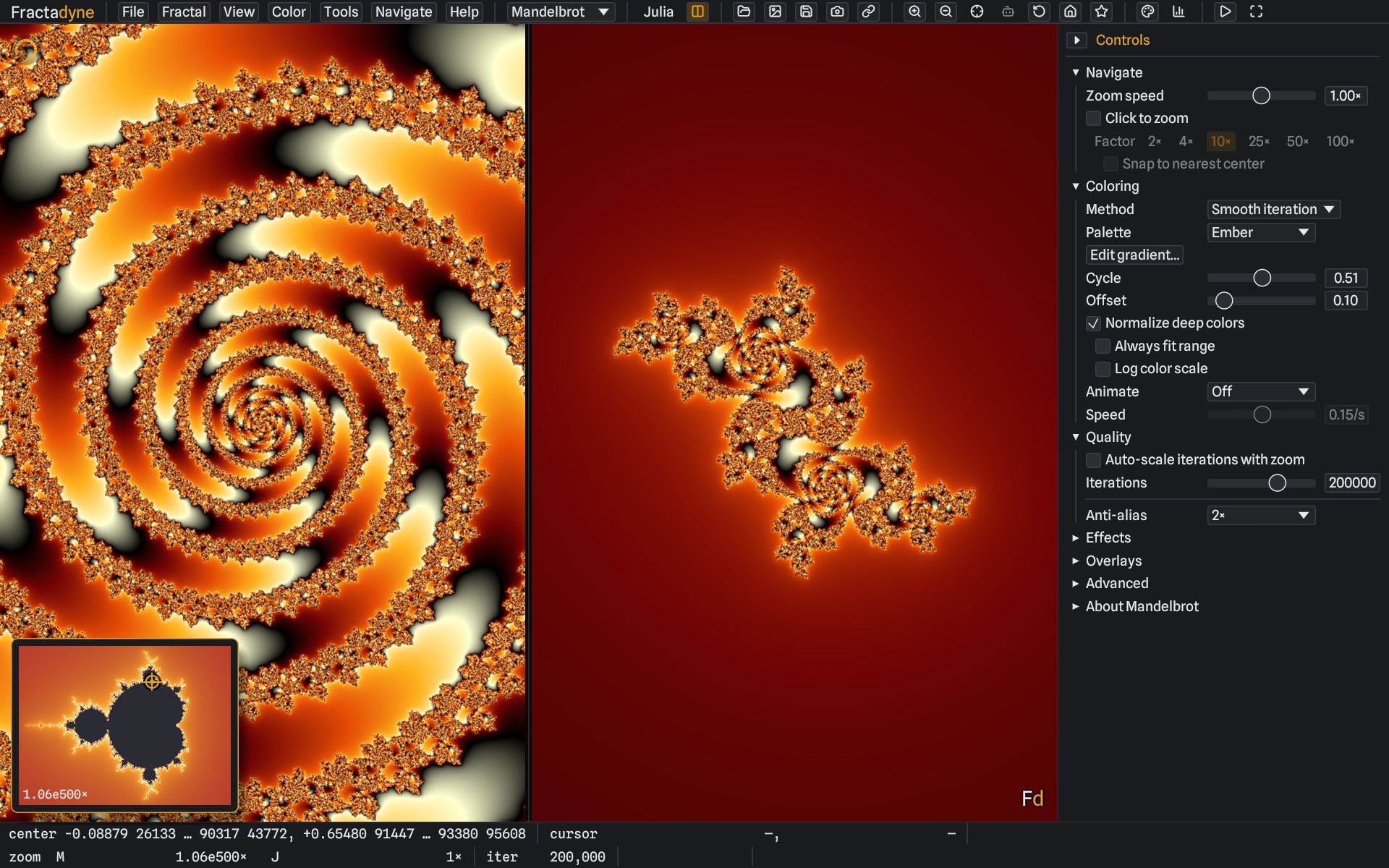
Fractadyne renders the Mandelbrot set and its relatives on the GPU, and keeps rendering them
correctly far past the point where ordinary floating point falls apart.
Zoom deep enough into a fractal and the arithmetic runs out of precision long before the detail
does. Fractadyne carries the centre of the view in arbitrary precision, computes one exact
reference orbit on the CPU, and expresses every pixel as a small deviation from it — switching
number formats automatically as the view deepens. So the depth you can reach is set mostly by
patience and by how much work the GPU will take, rather than by the arithmetic giving out.
It is free, open source, and a single self-contained executable: no installer, no runtime, no
account.
This is a work in progress. Fractadyne is under active development and has not
had a wide release. It is written and tested mostly on one machine, so other GPUs and drivers
are the least-proven part of it, and deep views in particular are still being worked on. There
is a list of the current rough edges further down — please read it before
deciding whether it is worth your time, and if something breaks, a report genuinely helps.
Unzip and run fractadyne.exe — 64-bit Windows 10 or 11, and a GPU with Vulkan,
DirectX 12 or OpenGL. Nothing is installed; delete the folder to remove it.
⚠Which build. The current build is v0.3.0-beta.9, a beta. The
0.3.0 betas continue the v0.2.41 series under a new version number. The
first button opens its release page, where the Windows zip, the Linux tarballs and the
accelerated variants all live; the few betas before it stay listed on the releases page. The old
stable v0.2.40 has been withdrawn so that nobody lands on a build a month behind.
Expect the Linux binaries to be less tested than the Windows build, because they are.
The releases page also carries downloads ending -accelerated — a .zip
for Windows and, from v0.2.41-beta.20, a .tar.gz for Linux. They are
optional and explained further down.
What it does
- Deep zoom, checked against another renderer. Twenty reference locations are
rendered against Fraktaler-3 and match its raw iteration
counts out to roughly 101105× magnification, with self-consistency checks
deeper still. Those are offline renders; see the limits below for what the live view does at
extreme depth.
- Interactive deep dives. Reference orbits are built ahead of where a dive is
going and scored across every CPU core, and the playback clock slows itself when the pipeline
falls behind.
- It measures its own cost. Each frame is timed on the GPU and the next one
is sized to fit that measurement, so a view too expensive to draw in one pass is drawn in
pieces instead of as one long submission. This is the part most actively worked on, and the
part most likely to behave differently on hardware I have not tested.
- Ten formulas — Mandelbrot, Multibrot 3/4/5, Tricorn, Burning Ship, Celtic,
Buffalo, Phoenix and Newton — each with Julia mode and a dual linked view.
- Colouring built for depth — six methods, editable gradients, and an
optional normalisation that helps keep deep images readable rather than banded.
- Guided tours. Scripted camera paths with per-keyframe budgets: play them in
the app, or render them headless to an image sequence or MP4.
- Exports — high-resolution PNG or 32-bit linear OpenEXR, with the view
embedded in the file so any exported image reloads exactly where it was taken.
The -accelerated download
It is the same program as the standard build, with one difference: it
computes deep-zoom reference orbits using the MPFR and GMP libraries instead of the
pure-Rust arithmetic the standard build uses. That step is the CPU pause before a deep view
starts resolving, and it runs roughly 2.5× to 6.4× faster there,
more so the deeper you go.
It is not a general speed-up. It does not raise the frame rate, and it does not change the
picture — the two builds produce byte-identical images. That is checked rather
than assumed: the same reference orbits across every formula, at arithmetic widths from 64 bits
to 132,000, plus the whole 39-location comparison corpus. A difference between them would be a
bug worth reporting.
- Your settings, session and saved locations live in your user profile, not beside the
executable, so the two builds share them — switch freely, nothing needs
importing.
- On Windows, keep the
.dll files next to fractadyne.exe; it will
not start without them.
- To see which one you are running: Help → About, the “Deep-zoom arithmetic” line.
Why it is a separate download, rather than simply being the build: MPFR cannot
be built with the Microsoft compiler the standard Windows binary uses, so it comes from a
different toolchain; and MPFR and GMP are licensed under the GNU LGPL v3, while Fractadyne
itself is MIT OR Apache-2.0. Keeping them in a separate, clearly labelled download leaves the
standard build free of those terms. The full notices and licence texts are inside the zip.
If you do not need it, take the plain download. The app will offer you this one later under
Help → Faster deep zoom, linked to the version and platform you are running. The Linux
accelerated tarball (beta track, from v0.2.41-beta.20) uses the system's GMP and
MPFR rather than bundling them, and needs GMP 6.3 and glibc 2.39 or newer — Ubuntu 24.04 or
equivalent — where the standard Linux build runs on 22.04.
Latest updates
v0.3.0-beta.9 — shallow zooms keep their detail while they move
Past about 104×, where the direct mode ends, a moving view used to show its
last complete picture stretched to follow the zoom — about 1.5× on average —
while the next one was rebuilt over a dozen frames or more, even when the graphics card could
draw the whole frame in a few milliseconds. Now a frame measured as cheap is drawn fresh and
shown at once. A dearer one, up to 36 ms of GPU work, is drawn in up to eight pieces, one
per displayed frame, each a checkerboard of small squares spread over the whole picture, while
the previous picture follows the zoom until the last piece lands. On the development card (an
RTX 3080 at 120 Hz, a 1280×800 window) the picture during a zoom from
106× to 1012× is now stretched about 1.08× instead of
1.54–1.60×, at 120 frames a second, and from 1012× to
1018× about 1.2× instead of 1.65×. Deeper than that the view
behaves as before.
The automatic iteration count also stops climbing on views that do not need it: at the
whole-set view it could run ten times higher than necessary for the rest of the session. On
the Radeon RX 6800 XT at a 1280×800 window the new drawing cannot make a piece cheaper
than the whole frame, so it stays out of the way there, and that fix is what shows: a zoom
from 104× to 4×10⁹× at 60 Hz now shows its
picture stretched about 1.5× instead of 2.2–3.2×.
v0.3.0-beta.1 — a new version number for a month of betas, and deep exports that keep the graphics card busy
The 150 betas since v0.2.40 went out as v0.2.41-beta.N. This
release marks that run as 0.3.0: it has the code of the last 0.2.41 beta, and the
changelog
now opens with a summary of the whole series by theme. It is still a beta, and the app's beta
update track offers it as the next build.
Deep exports are faster again. An export renders the picture in tiles, one after another,
and each tile was sized as if every pixel ran every iteration, so at high iteration counts
the tiles were too small to keep the graphics card busy. Deep tiles are now much larger, and
what keeps each piece of GPU work short is a limit on the steps each pixel may take in it. On
the development card a 4K image at 10148× takes 6.4 seconds instead of
11.5, and at 10275× 2.5 instead of 4.1. On the Radeon RX 6800 XT the graphics
card's share at 10148× fell from 6.9 to 4.4 seconds, and no single piece
of work took longer than 176 ms. The new and old tiling produce identical pictures. The
changed GPU program moves 3 pixels of 8.3 million at 10275× in the standard
build compared with the previous beta, and the standard and accelerated builds now agree
there exactly, as they do at the other scenes checked. The log also reports the GPU time of
every export and how long writing the image took.
v0.2.41-beta.148 — much faster deep exports, and a safety stop for a runaway GPU frame
Deep renders are many times faster: on the development card a 4K image at
101105× now takes 2.5 seconds, where beta.139 took 76. Four changes do
most of it. Exports of Mandelbrot and Multibrot views no longer run glitch correction — a
new check against exact arithmetic found that it repaired nothing there and made a few pixels
worse. The work before rendering starts (the reference orbit and the series approximation)
is no longer repeated, and runs in parallel. A deep step switches to cheaper arithmetic once
that is safe. And a command-line --render starts that work before its window
opens. Dropping glitch correction changes a few pixels, for the better wherever the check can
tell, and on the development card the cheaper arithmetic changes up to 0.14% of pixels by
fractions of an iteration; the other changes leave the picture identical to the pixel.
A new safety stop catches a frame that runs dangerously long and backs the app's frame
budget off. On the Radeon RX 6800 XT, in a test that recreates the conditions of an earlier
driver reset, it kept the machine running where the previous build hung it. Each graphics
card also gets a fixed cap on how much work it is given at once. Zooming no longer freezes on
a blown-up picture that looked like a single colour, and a command-line render that takes
longer than about a second no longer reports a failure it did not have.
v0.2.41-beta.116 — an auto-zoom that heads for detail and keeps the picture on screen, a Misiurewicz target, crash reports with evidence in them
The auto-zoom (the A key, or the ship's-wheel button) now steers toward the
richest edge in view instead of drifting into flat, empty regions, and eases into its dive
instead of sliding sideways as it starts. It no longer flashes to black or to a single colour
while it moves, and at extreme depth it goes blank far less often. A new Auto-zoom
priority chooses between speed and picture quality, and Auto-zoom target can
now pick the nearest Misiurewicz point and dive into it exactly. View → Show
auto-zoom target draws where it is heading, and when it stops because the iteration
count ran out, it says so.
Behind that, the app now keeps a record of the last few thousand frames it drew — what
it was asked for, what the GPU did and what reached the screen — in a file that survives
the app being killed, and a crash report carries it. Every build names the commit it came
from (title bar, Help → About), Report an issue no longer includes your user
name, and the log rolls over instead of growing without limit. None of this changes a
picture; it is there so that the next crash arrives with evidence.
v0.2.41-beta.108 — smoother live zoom, click-to-zoom in the dual view, deep colours that stay readable
Live zooms are paced for smoothness at every zoom speed. An interactive zoom now builds
reference orbits ahead of where you are heading, as a scripted tour always did, and each
refresh is sized from what the GPU actually measured: on the development card the worst frame
of a 1× to 10100× dive at the fastest zoom speed fell from 246 ms to
61 ms. A settled deep view still sharpens by progressive supersampling, and no longer
leaves a faint copy of the previous location behind it; a large click-zoom no longer flashes
black while the new view builds; and a shallow view no longer runs a hundred times the
iterations it needs.
Click to zoom works in either panel of the dual view, with a new 25× step, an optional
snap onto the nearest minibrot centre, and a magnifier on Shift that previews
where a click will land, with four times finer aim. Normalize deep colors now
decides from how much of the view actually aliases — before, at the default Cycle, it
could never switch on at all — and a new Always fit range spreads the palette
across what is on screen whenever you ask. The nearest-minibrot key (M) works
in the dual view and no longer freezes the window at depth, and the gradient editor opens
on the palette you are actually using.
Full history in the
changelog.
The app can check for updates itself (Help → Check for updates); with no stable release
on the page at the moment, the beta track is the one that finds anything.
Where it is rough
Named here rather than discovered later. None of these are secret — they are the things being
worked on, in roughly the order they are likely to affect you.
- Deep views are slow, and degrade while you move. During a zoom the picture
is coarser than the still image you get once it settles, and at extreme depth settling can
take a while.
- Extreme depth is slow the first time. The deeper the view, the longer the
reference orbit takes to build before anything resolves — minutes around
104000×, and about six and a half hours at the deepest location we track,
1060205×. From v0.2.41-beta.78 that orbit is kept on disk, so a second
visit to the same place, or anywhere near it, takes seconds. Some locations still need more
reference samples than the live view holds; the app says so in the status bar rather than
showing an unexplained black screen, and an offline render can sometimes resolve what the
live view will not.
- Glitch correction on exports can be very slow when you ask for a very high
iteration count at extreme depth — minutes, not seconds. From v0.2.41-beta.140 it no longer runs
for Mandelbrot and Multibrot exports, where it was found to repair nothing; the other formulas
and Julia views keep it until the same check has been done for them.
- Rendering a long tour offline has no memory or per-frame cost bound. Give
it a big frame size and a deep path and it can grow until the machine complains.
- A very large or very deep export can still lose the graphics device.
Splitting the work into watchdog-sized pieces removed the clearest cause, and a full-quality
export of a deep view now survives where it used to fail early — but a multi-hour export
at the extreme end can still drop the device late in the render on some drivers. It is the most
actively worked-on problem; the crash report it writes is exactly what helps.
- Zooming can lose the graphics device on at least one AMD card. On the Radeon
RX 6800 XT used for testing, a live zoom at a modest depth has reset the graphics driver more
than once. From v0.2.41-beta.131 a safety stop catches the runaway frame behind it, and in a test
that recreates those conditions the app now survives where earlier builds hung the machine
— but the underlying cause is not fully understood, so treat it as mitigated, not fixed.
If it happens, the app leaves a record of its last few thousand frames behind, which is exactly
what a report needs.
- A very high iteration setting can make the window unresponsive. Millions of
base iterations on a large window at depth can give the GPU more work per frame than it
finishes in time, and the app then answers input only about once a second. It notices this
happening but does not yet back out on its own — if you hit it, lower
Iterations (base). Closing the app is not enough: the setting is saved with your
session and comes back the next time you start it.
- Hardware coverage is thin. Development happens on one NVIDIA card. An AMD
card now runs the validation suite on every release, and still differs from the development
card in places — one of its self-test checks fails there and nowhere else, and on it the
cheaper deep arithmetic of beta.141 changes up to 8% of pixels at some locations (0.14% at most
on the NVIDIA card), all in chaotic fine detail where a check against exact arithmetic favours
neither version. Help →
Diagnostics runs that self-test on your machine so a report can carry evidence.
- The Linux build is young. Linux binaries ship with every release, but
Windows is the platform that gets tested, so treat Linux as early.
- Not present: custom formulas, layer compositing, 3D. Export size is capped
by what the GPU can allocate at once.
At a glance
| Platform | Windows 10/11 64-bit; Linux x64 |
| Graphics | Vulkan, DirectX 12 or OpenGL, via wgpu |
| Written in | Rust, with egui for the interface |
| Licence | MIT or Apache-2.0, at your option |
| Price | Free, and free of tracking, ads and accounts |
Getting in touch
Bug reports and feature requests are best filed as
GitHub issues — they are public
and searchable, so other people can confirm and follow them. The app can open a prefilled report
for you from Help → Report an issue, including the version and hardware details.
If you would rather not use GitHub, write to
feedback@fractadyne.org.